
Why Agentic AI Chatbots Are Transforming Healthcare in the Gulf Region
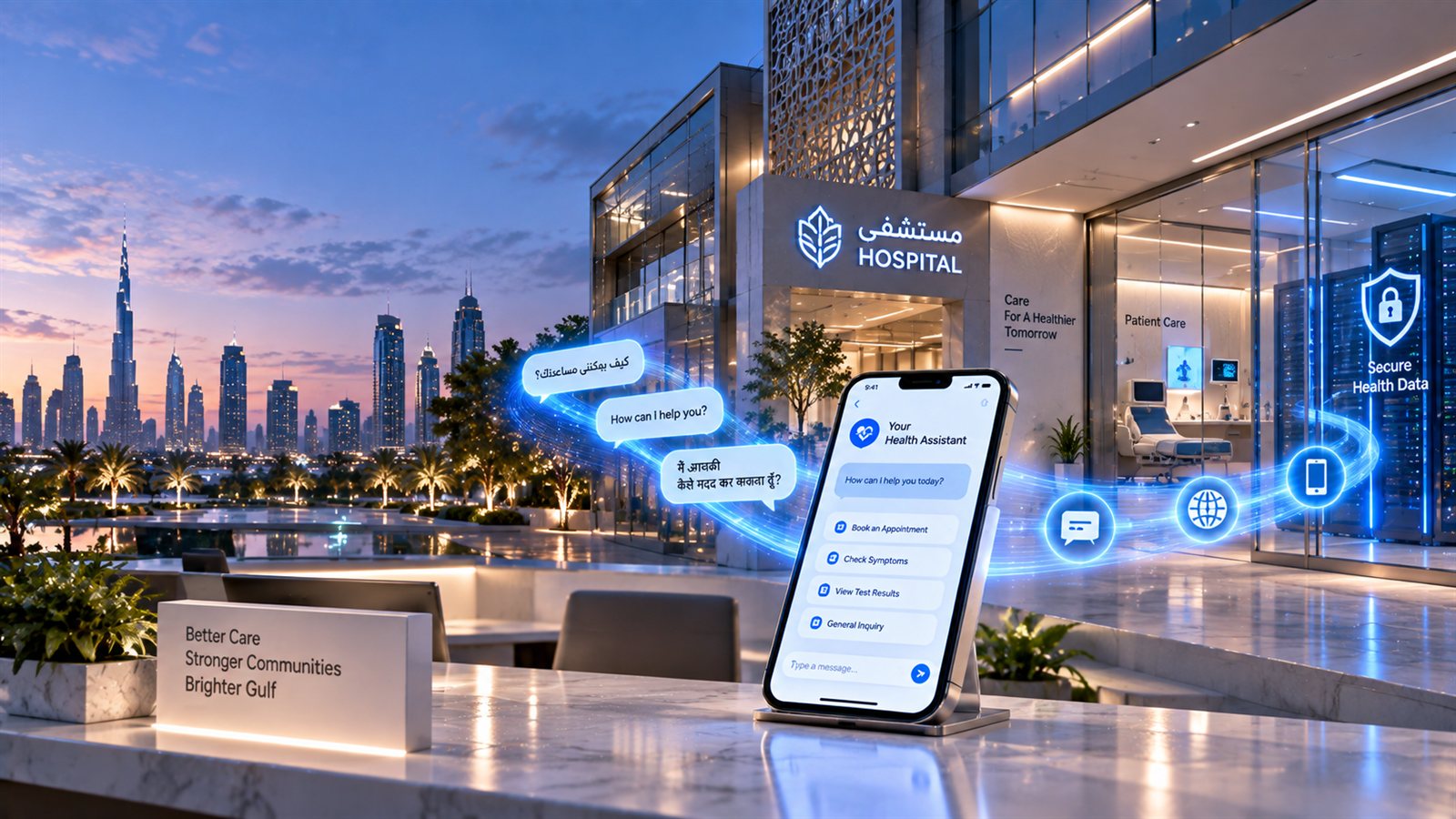
Multilingual, omnichannel AI assistants are reshaping patient interactions across the GCC — here is what's driving adoption and what compliance requires.
Across the Gulf, healthcare providers are using agentic AI chatbots — systems recognized as a leading technology trend by Gartner — to do far more than answer questions. These assistants act autonomously: scheduling appointments, running symptom assessments, and translating conversations in real time, which matters enormously in a region where expatriates make up more than half the population in countries like the UAE and Qatar.
Multilingual, context-aware translation addresses one of the region's biggest care gaps — a nurse in Kuwait can explain a procedure in Tagalog while the attending physician reads it in English. Gartner projects that by 2028, 90% of global enterprises will rely on AI-based real-time translation to serve diverse populations, and Gulf healthcare is an early adopter.
Patients also expect to move seamlessly between channels — starting a query on a hospital website, continuing over SMS, and booking through WhatsApp without losing context. Saudi Arabia's Ministry of Health has already deployed AI-driven virtual assistants across SMS, apps, and call centers, and industry forecasts point to omni-channel AI driving a significant increase in patient engagement over the next few years.
None of this works without trust. Compliance with data protection laws like the UAE's PDPL and Saudi Arabia's PDPA is essential, and explainable AI — systems that can justify why a patient was referred to a specialist — is what turns adoption into confidence. With Saudi Arabia committing tens of billions of dollars to healthcare under Vision 2030, automating routine administrative work like billing and follow-ups is also becoming a meaningful cost lever, with estimates suggesting AI-driven automation could cut Gulf healthcare costs by up to 20%.
Early implementations — from multilingual patient communication at major Abu Dhabi hospitals to private UAE hospitals automating appointment scheduling — point to where this is heading: AI assisting clinical decision-making, integrating with wearables for real-time alerts, and delivering personalized guidance based on individual medical records. Gartner expects the large majority of healthcare enterprises to have adopted advanced AI by 2026, making this a competitive necessity rather than an experiment.
Key takeaways
- Agentic AI chatbots handle real tasks — scheduling, symptom triage, translation — not just Q&A.
- Real-time multilingual translation directly addresses the Gulf's highly diverse patient population.
- Omni-channel continuity (web, SMS, WhatsApp) is becoming the expected standard for patient engagement.
- Compliance (UAE PDPL, Saudi PDPA) and explainable AI are prerequisites for patient trust, not afterthoughts.